The Anchor and the Alibi: How to Pick a Club Meeting Point That Survives the Night
Photo: DeFacto, CC BY-SA 4.0, via Wikimedia Commons
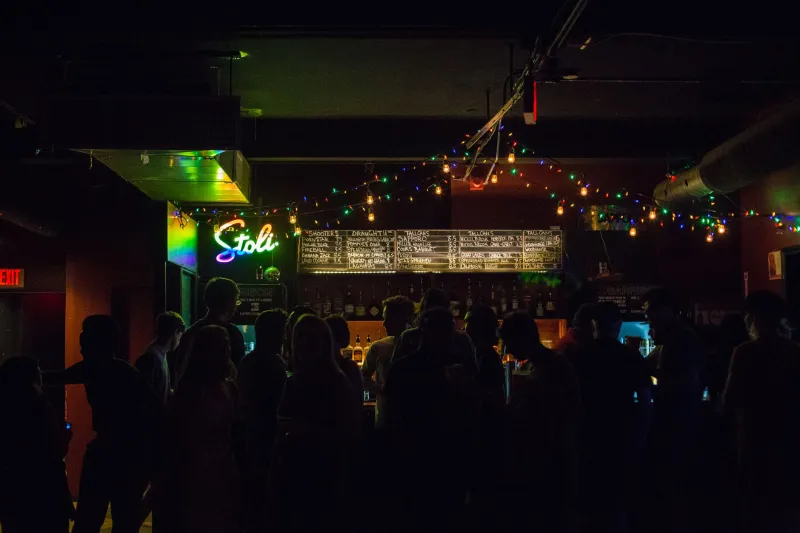
At 12:47am, your phone is at three per cent, the bass has eaten six texts and the group chat has dissolved into a series of increasingly vague pins. You agreed to meet 'by the bar'. There are three bars. This is not a personal failing. It is a design problem — and the fix is older than the QR code: pick a proper meeting point.
Meeting points are the unglamorous infrastructure of a night out, as essential as a working hand dryer and as overlooked as the sign above the fire exit. They shape who you bump into, how long you spend orbiting the dancefloor and whether the night ends in a shared cab or a solo scroll through missed calls. Consider this your Club Clio field guide to choosing an anchor that holds when everything else is moving.
The Fruit Machine Was Never Really About Fruit
The fruit machine is the classic for a reason. It is fixed, illuminated, usually near a corner and impossible to confuse with anything else in the room. You can loiter beside it without looking like you are waiting for a dealer, and it gives you something to stare at when the person you are meeting is late. In social clubs and proper pubs it still earns its keep; in newer venues it has often been replaced by a photo booth, a vending machine or a neon sign with a slogan about dancing. The principle survives even when the fruit does not: choose a landmark that glows, stays put and can be described in five words.
If the venue no longer has a fruit machine, look for its spiritual successor. A photo booth is excellent — it is lit, distinctive and designed for standing around. A giant mirror by the loos works if there is only one. The merch desk is good early on, less good once the queue has gone. The test is simple: can a slightly drunk person find it without asking staff, and can they stand next to it for ten minutes without being moved on?
Your Phone Is Not a Meeting Point
Texting 'where are you?' from inside a club is a lovely ritual and a terrible strategy. Concrete, steel and 3,000 bodies do not care about your notifications. Messages arrive late, arrive twice or arrive tomorrow. Live location is a rumour indoors. A screenshot of the venue map helps nobody who is standing in the dark wondering whether the corridor by the loos is the same corridor they are in.
Agree the plan before you go in. That means a primary point, a backup point and two clock times: one early check-in and one final fallback. Use actual times, not 'later'. 'If we are not together by 1, go to the cloakroom wall' is a plan. 'See you inside' is a wish. And send descriptive messages while you still have signal: 'Green jacket, left stack, near the photo booth' beats 'where r u' every single time.
The Landmark Hierarchy
Not all meeting points are equal. Think of them in tiers, from the reliable to the romantic.
Tier one: fixed, lit and unmistakable. Fruit machine, photo booth, giant mirror, cloakroom queue, merch desk, the left or right speaker stack. These are the landmarks that survive a crowd.
Tier two: semi-fixed and specific. The small bar by the fire exit, the DJ booth corner, the stage lip, the pillar with the sticker on it. These work if you name them properly. 'The bar' does not. 'The bar with the neon sign and the queue that never moves' does.
Tier three: ambient and weather-dependent. The smoking area bench, the loo corridor, the stairwell. Useful, but prone to traffic, queues and the sort of echo that makes shouting sound like a bad idea. Keep them as backups, not first choices.
Avoid 'by the door' unless there is only one door and nobody is smoking outside it. Avoid 'near the loos' if the venue has two sets of loos. Avoid the centre of the dancefloor unless you genuinely enjoy the needle-in-a-haystack feeling. Venue layout matters, too: a railway arch funnels everyone down one main artery, a basement has sound pockets and low ceilings, a warehouse has pillars that act like natural signposts, and a pub-turned-club has rooms that need naming. 'Meet in the room with the mirror ball' is a sentence that saves friendships.
The Cloakroom Queue Is a Social Contract
Everyone returns to the cloakroom. That is what makes it such a good rendezvous: it is at the edge of the room, it is usually lit, and there is a queue you can stand beside without looking odd. The trick is not to stand in the queue itself. Park yourself on the wall opposite, or by the sign that says 'No drinks beyond this point', and let the world come to you. In 2026, QR coat checks have shortened the queues, but the cloakroom remains a fixed point in a spinning room. It is also where lost property lives, which means it is where half the night's best conversations happen anyway.
Speaker Stack Diplomacy
Agree left stack or right stack before you go in. The stack is loud, but its silhouette is unmistakable, and standing to the side of it gives you somewhere to lean that is not the bar. It also puts you close to the music without trapping you in the crush. The bass will still swallow your texts, so treat the stack as a physical anchor rather than a communication hub. If you have agreed to meet there, be there. Do not drift to the other stack because the view is better. That is how legends of 'we kept missing each other' are born.
The Signal Wall and Other Folklore
Every venue has a rumour of a signal spot: the corner by the fire exit, the tiled corridor by the loos, the stairwell where one bar of 4G flickers into life. In 2026, Wi-Fi calling and eSIMs help, but concrete still wins. Treat the signal wall as a bonus, not a plan. If you need to send a message, send it before you lose signal. If you are waiting for one, give it a clock time and then move on. The night is long; the group chat is not.
A 2026 Rendezvous Checklist
Pick a primary point that is visible from the entrance and outside the loudest zone. Pick a backup in a different room or zone. Set two clock times. Describe what you are wearing. Name the bar if there is more than one. Choose a landmark that staff know, too, so a lost friend can ask for 'the photo booth' rather than 'my mate'. And keep it kind: meeting points fail, plans wobble, people end up by the wrong stack. The point is not to be perfect. The point is to give each other somewhere to aim for when the bass is doing its best to erase all geography.