Vinegar Diplomacy: Why the Night Ends at the Counter, Not the Cab
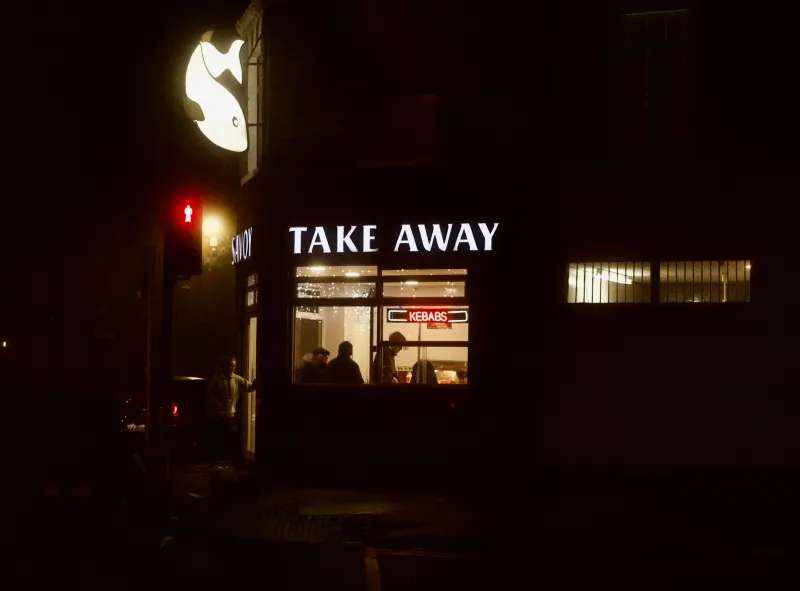
At 2:47am, the club has already said its goodbyes. The last tune has faded, the cloakroom has coughed up its last coat and the group chat is doing that thing where everyone claims they are definitely getting a taxi in five minutes. But the night is not over. It has simply moved to a strip-lit room with a menu board held up by Blu Tack, a bin full of greaseproof paper and a queue that smells of salt, vinegar and possibility.
The real afterparty is not always a warehouse with a bloke playing one more remix while someone tries to find the light switch. Sometimes it is a chippy on the corner, a kebab van with a generator humming like a wasp in a bin, or a 24-hour bakery where the lighting is unflattering and the pasties are honest. This is where the night gets its second act: not curated, not ticketed, and considerably better for it.
The Final Room Has a Menu
There is a reason the post-club food queue feels like the last room of the night. Everyone arrives with the same job: get something hot and salty into their hands before the cab app gives up or the group splinters. The social hierarchy has collapsed. The person who got in everywhere because they knew the promoter is now standing behind the person who spent the last hour crying by the smoking area. Nobody cares. The bouncer is off duty and eating chips. The door politics have dissolved into vinegar.
And unlike the club, nobody is pretending the queue is the main event. That is precisely why it works. The night has already happened. The pressure to have a good time is off. You are not trying to look like you are having the best night of your life; you are trying to decide between a battered sausage and a bag of chips with enough vinegar to strip paint. The conversation follows.
Why the Queue Beats the Smoking Area
Smoking areas are for performance. They are where you go to be seen having a deep conversation, or to ask someone what they do, or to explain why the DJ’s set fell apart after midnight. They are fine, but they are a stage. The chip shop queue is a workshop. You are side by side rather than face to face, which is the most underrated social technology Britain has. It is why bus stops, football queues and chippy lines produce better chat than most networking events. The pressure is off. You can say nothing. You can say something. The vinegar bottle is right there as a conversational crowbar.
There is also a shared task, and shared tasks make strangers nicer. Everyone is moving in the same direction, towards the counter. Nobody is trying to get one over on anyone, unless it is the person who orders fourteen separate items at 3am. That person is a menace, but they are our menace. The queue gives you a temporary, low-stakes crew: the people who will nod when your mate says the last club was ‘dead but in a good way’, the people who will help you decide whether you need a pickled egg, the people who will not ask what you do for a living because they are too busy working out what they want.
The Queue Zodiac: A Field Guide
Every post-club queue has its characters. You will recognise them. You may have been them. Ranked here in rough order of usefulness to the night:
-
The Chip Shop Diplomat. Keeps the group together, remembers who wanted salt and vinegar, negotiates with the counter staff and somehow leaves with everyone’s order plus a bag of batter scraps. The glue of the operation.
-
The Kebab Van Philosopher. Has been waiting for this moment. Will explain the meaning of life between a chicken shish and a can of Fanta. Unexpectedly wise. Slightly too loud. You will think about their point about time and chips for the next three days.
-
The Vinegar Vigilante. Believes there is no such thing as too much vinegar. Douses their chips with the confidence of someone who has never had to eat a soggy chip in their life. They are wrong, but they are committed, and that counts for something.
-
The 24-Hour Bakery Ghost. Slips into the bakery queue, buys a pasty for tomorrow and a doughnut for now, says almost nothing and disappears into the night. Deeply mysterious. Probably has their life together.
-
The Taxi Rank Refusenik. Has a cab waiting but is holding a bag of chips and refuses to get in until they have finished. Treats the queue as a final encore. You respect the commitment, even as the driver cancels.
-
The Group Mum or Dad. Does a headcount, distributes chips, finds the person who wandered off, and gets everyone into two cabs with the efficiency of a festival steward. They are tired, but they are not leaving anyone behind.
-
The Sauce Negotiator. Wants to know exactly what sauces are available, in what quantities, and whether the garlic mayo is house-made. They hold up the queue. They also get the best result. It is complicated.
The Greaseproof Map of a City
The queue is also a map. It tells you which club has just emptied, which night has the friendliest crowd, which street to avoid at 3am and which van is worth the walk. A long, laughing queue outside a chippy is a good sign. A silent queue outside a kebab van is either a serious post-club crowd or a fight waiting to happen. Either way, mind your chips.
In Glasgow, the van might be the whole point of the night out. In Manchester, the queue can turn into a debate about the correct ratio of rice to sauce. In Cardiff, a chippy queue at 3am has the energy of a post-match debrief. In London, the queue is a place where people from completely different nights briefly become neighbours. The food changes; the function does not. It is the city’s nightlife written in greaseproof paper.
The Vinegar Test
Here at Club Clio, we have long argued that the best UK nights are not judged by the club’s last tune. They are judged by what happens between the taxi rank and the vinegar bottle. Did you talk to a stranger without wanting to leave the country? Did someone share their chips? Did the group mum get everyone home with a bag of scampi fries and their dignity intact? That is the vinegar test.
The club is the headline. The chip shop is the bit everyone quotes the next day. It is where the night gets edited into a story, where the gossip settles, where the random dancer becomes a legend and the DJ’s final tune is either vindicated or quietly forgotten. The queue is not the comedown. It is the encore. And it is, always, worth waiting for.